


The Discovery of Coal
For many years people believed coal might exist beneath Kent but it was not confirmed until exploratory drilling in the 1880s. Engineers who had been working on early plans for a channel tunnel between Britain and France began drilling test holes in East Kent and discovered coal deep below the countryside. In 1896, businessman Arthur Burr gained the rights to mine the coal and began work on Kent’s first pit at Shakespeare Cliff near Dover.
Mining conditions were difficult. The coal seams were thin, uneven and often flooded with water, making Kent one of the most challenging places in Britain to mine coal. However, the coal itself was high quality and burned very hot, making it valuable for industry.

The Kent Collieries
Although early plans suggested as many as twenty coal mines could open, only four major collieries became established:
Tilmanstone Colliery 1906 - 1986 (first coal 1913)
Tilmanstone had a unique aerial ropeway that carried coal in containers through the air from the mine to Dover Harbour, moving around 120 tons of coal every hour.
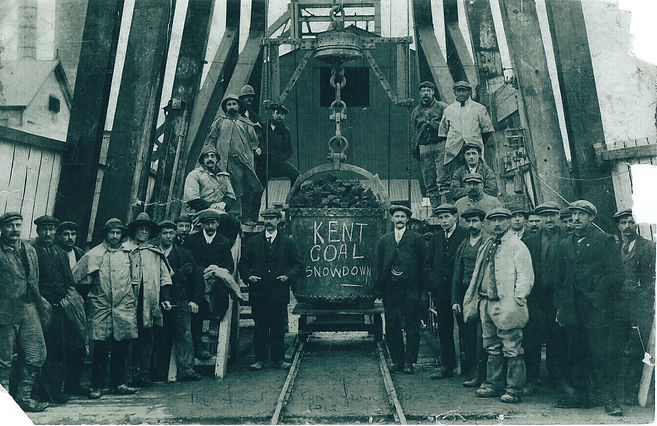
Snowdown Colliery 1907 - 1987 (first coal 1912)
Snowdown was the deepest mine in the Kent Coalfield, reaching around 3,000 feet (915 metres) underground. Temperatures were so hot that some miners worked wearing only their underwear.
Chislet Colliery 1914 - 1969 (first coal 1919)
Chislet Colliery helped create the nearby mining village of Hersden, where hundreds of homes were built for miners and their families. It was also the training site for the Bevin Boys during World War II.
Betteshanger Colliery 1924 - 1989 (first coal 1927) Betteshanger was the largest coal mine in Kent and the last one to close, marking the end of coal mining in the county after nearly 100 years.


New Mining Communities
During the 1920s many miners moved to Kent from traditional mining regions such as Wales, Yorkshire, and the North East of England. More than 5,000 miners travelled to East Kent looking for steady work.
New villages were built for miners and their families, including Aylesham and Hersden, Mill Hill and Elvington. These communities developed strong traditions, social clubs, sports teams, and colliery bands that became an important part of local life.
Strikes and Change
Mining communities were closely connected to trade unions, which fought for better pay and safer working conditions. Kent miners took part in major national events including the 1972 and 1979 strikes and the Miners’ Strike of 1984–1985. These disputes showed the strength and unity of mining communities across the country.

The End of Mining in Kent
After the 1980s miners’ strike, coal mines across Britain began closing. The remaining Kent collieries shut one by one - Betteshanger Colliery being the last to close in 1989, bringing nearly 100 years of coal mining in Kent to an end.
Coal mining shaped the towns and communities of East Kent. Although the mines have now closed, their legacy lives on in the people, places, and stories of the region. The Kent Mining Museum works to preserve this history and share the experiences of the miners and families who helped power Britain’s industries.